BSc Full Form: Bachelor of Science — Everything You Need to Know
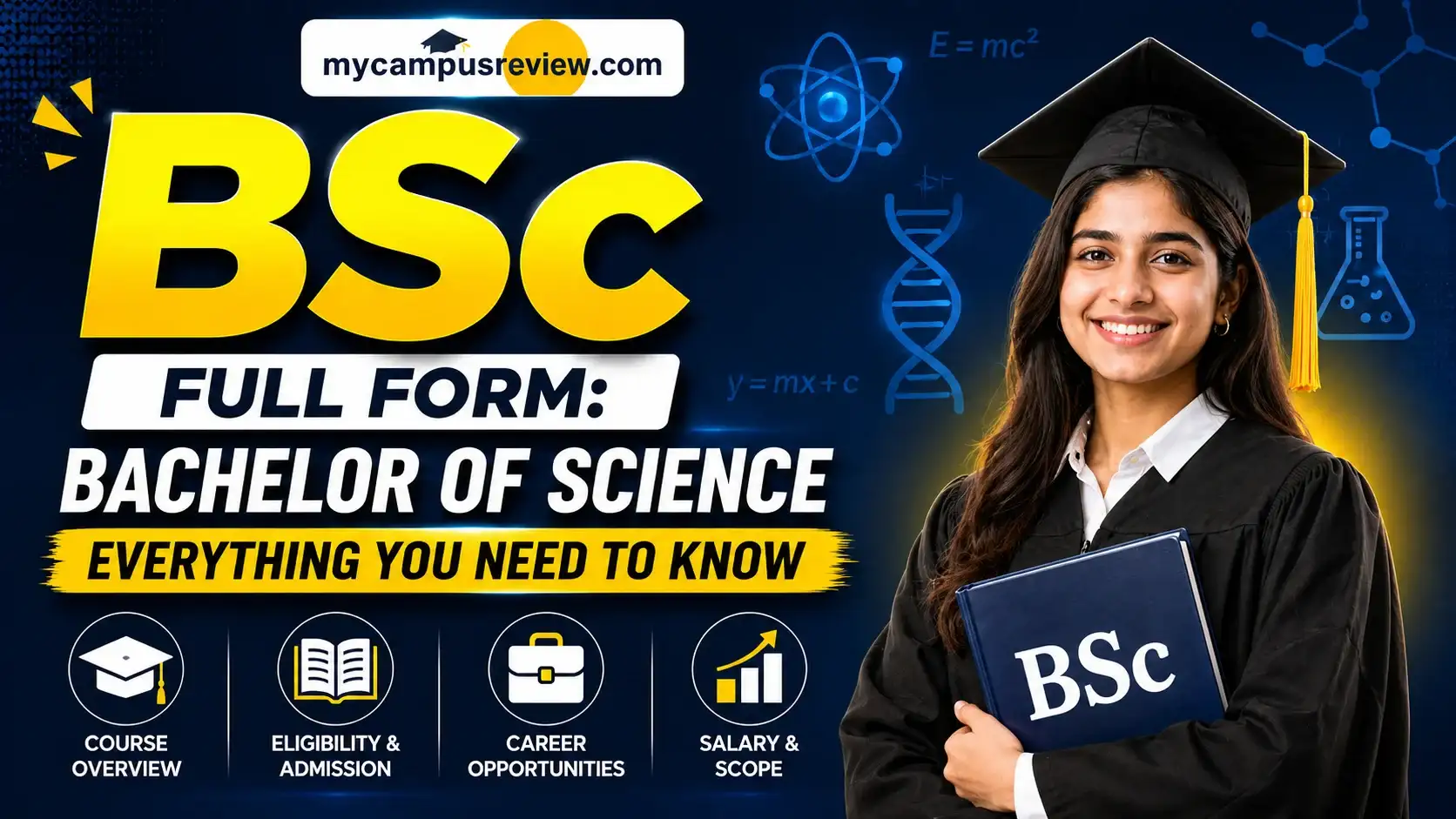
The full form of BSc is Bachelor of Science. A BSc degree is one of the common undergraduate qualifications. It is given to students who complete a programme of study in a technical or applied science subject. BSc can also be written as B.Sc., B.S., or S.B. BSc is valued in more than 150 countries. It is a benchmark qualification for students seeking careers in Science, Technology, Engineering and Mathematics (STEM) fields. A BSc is a step toward formal education.
A Brief History of the BSc Degree
The University of London granted its Bachelor of Science degree in 1860. At that time, universities were distinguishing study from Bachelor of Arts (BA). During the century industrialization increased the need for trained men and women of science and engineering. Since then, the BSc degree has grown steadily. It now includes hundreds of specialisations. These specialisations include computing, biotechnology, agriculture, nursing, data science and more.
BSc vs BA: Understanding the Difference
A question is: What is the difference between a BSc and a BA (Bachelor of Arts)? They are both programs. They are very different in their approach. A BA involves studying humanities, social sciences, arts, literature, history and philosophy. A BSc is designed for thinking, math, empirical study and experimentation. BSc programmes are usually more structured. There is increased emphasis on mathematics, statistics, laboratory work and research methods.
Duration and Structure
Depending on the country, a BSc programme can last for:
India, UK, and Australia have each had a 3-year plan.India, UK, and Australia have had a 3-year plan.
• USA and Canada — 4 years
Most universities in India operate on a semester basis, and students spend a period of three years, completing six semesters. The Choice-Based Credit System (CBCS) is adopted by many institutions, which gives the students some flexibility in choosing optional subjects outside the mandatory syllabus of the course.
The BSc programme comes in two main formats:
• BSc General — Gives general and broad knowledge of various science disciplines. For students desiring more exposure.
• BSc Honours — Specialised study in one subject in depth. Usually needs to write a dissertation or project. Ideal for students wanting to do further studies, including MSc or PhD.
Eligibility Criteria
Eligibility criteria for applying to the BSc program in India are:
• Passing of Maths/ Biology (PCM/B) at Class 12 (10+2) from any recognised board.
• A minimum aggregate score of 50% marks in qualifying examinations (may vary by institution).
• Some universities may require students to appear for entrance examinations.
Some of the most popular BSc entrance exams in India are CUET (Common University Entrance Test), ICAR AIEEA, KCET, MHT CET, and AP EAMCET, to name a few. There are also a few colleges that provide direct admission for students on the basis of marks obtained in their Class 12 board exam.
Popular BSc Specialisations
The BSc is one of the most versatile degrees offered. Indian universities offer more than 114 specialisations under BSc. The most popular ones are:
• BSc Computer Science — Programming, Software Development, Algorithms and Data Structures. Highly in-demand in the IT industry.
• BSc Physics — Studies classical mechanics, electromagnetism, quantum physics and thermodynamics.
• BSc Chemistry — Concentration on Organic, Inorganic, Physical Chemistry and practical training.
• BSc Biology — Zoology / Botany — Life sciences, ecology and genetics, cellular biology.
• BSc Mathematics — Provides excellent mathematical, analytical and problem-solving abilities in both pure and applied mathematics.
• BSc Biotechnology — Integrates technology and biology; used in medicine, farming and pharmaceuticals.
• BSc Data Science — A relatively new specialisation that concentrates on areas such as machine learning, statistics, and data analysis.
• BSc Nursing — It is a course that educates students in the area of patient care, medical procedures, and clinical practice.
• BSc Agriculture — includes crop science, soil science, agronomy and food technology.
• BSc in Environmental Science — Focuses on ecology, conservation, pollution control, and sustainability.
Modes of Study
There are various modes of BSc programmes to suit different kinds of learners:
• Full-time (Regular) — Normal study in a college or university. Perfect for 12th grade graduates in the process of getting used to school life.
• Part-time / Distance — For working people. Distance BSc degrees are accepted as valid degrees by the University Grants Commission (UGC), as long as the university is UGC-DEB approved.
• Online — Self-paced online learning delivered by a few recognized universities. This is especially helpful for those who want to study from home.
Career Options After BSc
Having a BSc degree can lead to a variety of career opportunities in different industries. Fresh BSc graduates in India can take anywhere from ₹2.5 – ₹6 LPA, depending upon the specialisation, skills and the employer.
Some common career options include:
• Software Developer / IT Engineer — For BSc Computer Science graduates
• Data Analyst / Research Analyst—Useful for various science streams
• Laboratory Technician / Chemist — Found in pharmaceutical and health care industries.
• Medical Representative — A popular career for Life Science students
• Environmental Specialist — (Environmental Science graduates)
• Content Writer / Science Communicator — If you are strong in Science and have a good writing ability
Some of the best recruiters for BSc are HCL, IBM, Google, Wipro, Cipla, Deloitte, Yahoo, and Verizon.
Higher Education After BSc
The BSc is also a stepping stone to further academic and professional qualifications. After completing a BSc, graduates can pursue:
The most common pathway to a postgraduate degree is an MSc (Master of Science) degree.
• MBA — Management courses for Science graduates transferring to business careers
• MCA (Master of Computer Applications) — For BSc Computer Science / IT graduates
• B.Ed (Bachelor of Education) — For those interested in teaching
• PhD — Research-based doctoral programmes for those pursuing academia
• Professional certifications — Data science, cybersecurity, clinical research, and others.
BSc Honours students are especially suited to postgraduate courses involving research.
Top Colleges Offering BSc in India
The following are some of the most renowned institutes for BSc courses in India:
• Delhi University (DU)
• Banaras Hindu University (BHU)
• Jawaharlal Nehru University (JNU)
• Jamia Millia Islamia
• Jadavpur University
• Aligarh Muslim University (AMU)
• VIT Vellore
College fees for BSc generally range between ₹5000 – ₹30000 per annum in government colleges and ₹50000 – ₹1,50000 per annum in private colleges based on their facilities and specialisations.
Conclusion
BSc (Bachelor of Science) is more than just a set of letters. It represents a disciplined, demanding, and enriching educational experience leading to a knowledge of science, skills of analysis, and competence. If your aspiration is to pursue a career in technology, healthcare, research or industry, the BSc degree can serve as a strong building block to success. There are 114 specialisations to choose from, flexible study modes and increasing industry demand make the BSc one of the most valuable undergraduate degrees a scientist student can choose in today's world.
Written By:

At MyCampusReview (MCR), we are a team of passionate education consultants, writers, and student mentors committed to guiding students on their journey.